Control what you spend in credits
Credits are the money of the product, and most of the surprise in a bill comes from two columns and one dialog nobody opens. Here is where the numbers are, how the multiplication works, and how to estimate before you spend instead of after.
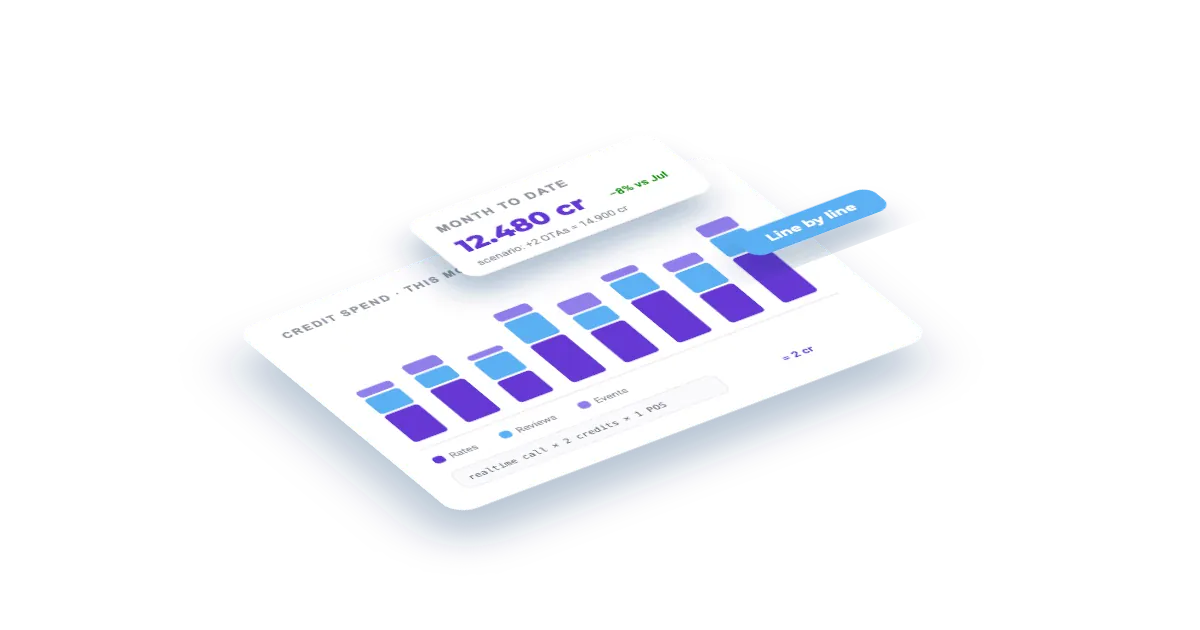
What you'll build
A read of your billing period you can defend: the feed/realtime/account split, who triggered each run, which answers came from cache, the exact arithmetic behind any charge, and the three estimators that price a scenario before you commit.
How it works
- 01The chip, then the screen
- 02Read the table before you conclude anything
- 03Why did *that* cost that? — the calculation
- 04Before you spend: estimate, don't guess
- 05Getting it out of the dashboard
- 06What happens next
Step by step
By the end you will be able to answer three questions with numbers off the screen instead of guesses: what have I spent, why did that particular line cost what it cost, and what would it cost me to do X.
What you need: nothing. Everything here is free to read, and the simulator is free to run.
The chip, then the screen
The credits chip in the header is the glance version — consumed this period, and a warning if you have gone over. Clicking it takes you to Billing · Usage, which is where the real answer lives.
Start with the summary bar, because it splits the total the way the product actually charges:

Feed, Realtime and Account credits are three different economics. Feed is charged per import execution — per entity, per day of visibility. Realtime is charged per request. Account is nearly free and only appears because some endpoints have a price. Add them up and you get Total credits; multiply by your Cost per 1.000 credits and you get the euros.
The Period selector matters more than it looks: it is the billing period, and it carries the plan that was in force then. Don't answer "how much did we spend" from the current period if the question was about last month.
Read the table before you conclude anything
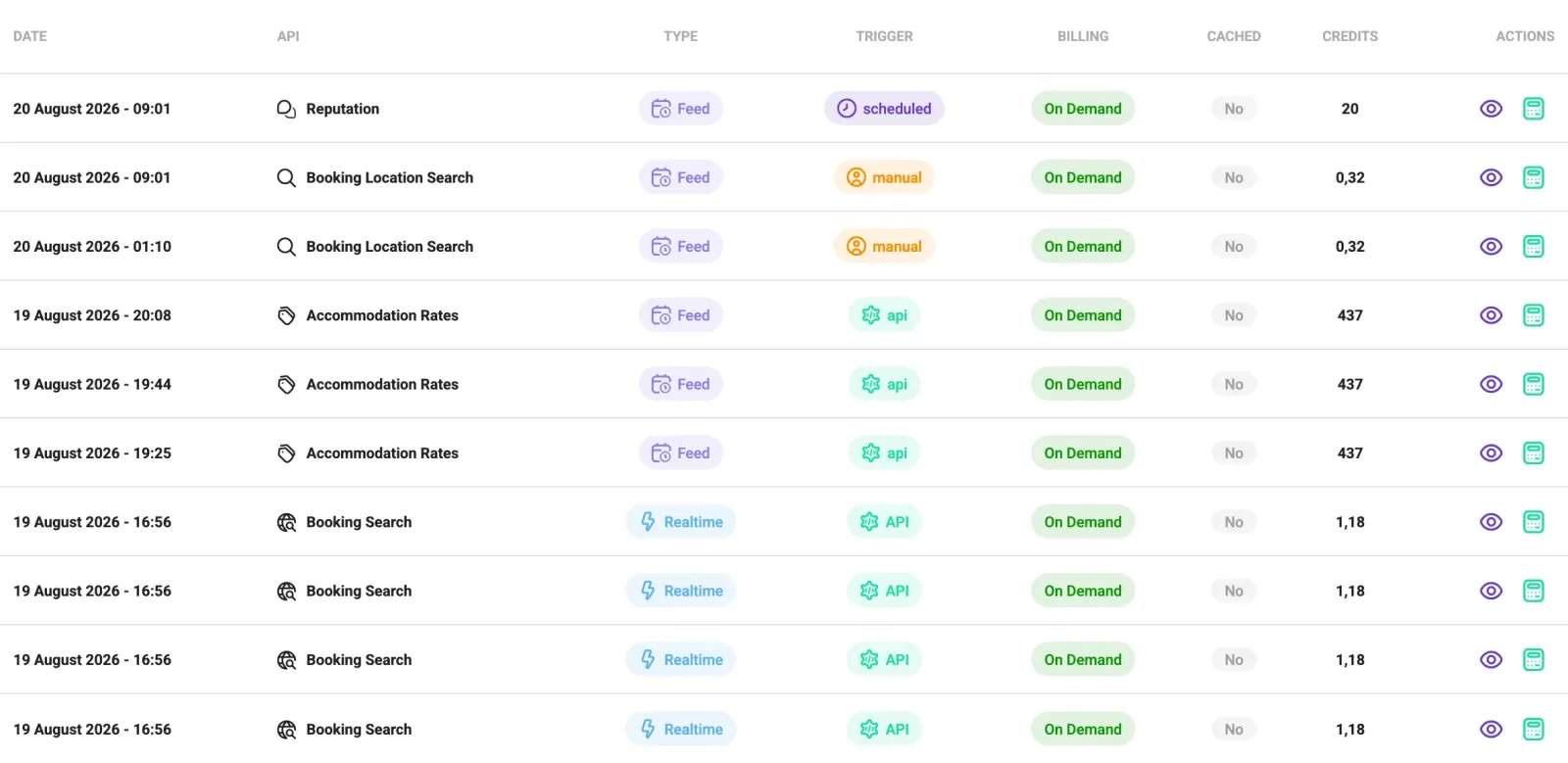
Two columns do most of the explaining:
- TRIGGER — who started it.
scheduledis your own automation,manualis somebody pressing the button in the dashboard,apiis your integration calling in,recoveryis Veetal retrying a failure. When a bill surprises you, this column usually names the culprit. - CACHED — whether the answer came from cache. A cached response costs nothing or less, and it is the first explanation for "why was this one free?".
In the table above the whole month is visible at a glance: three Accommodation Rates runs at 437 credits each triggered by api, one Reputation run at 20 triggered by scheduled, two Booking Location Search imports at 0,32 each launched by hand, and a handful of Booking Search real-time calls at 1,18. Three api-triggered runs account for more than half the period.
Why did that cost that? — the calculation
This is the part most people never find. The last icon in ACTIONS opens Calculation details, and it shows the arithmetic, not a summary of it:
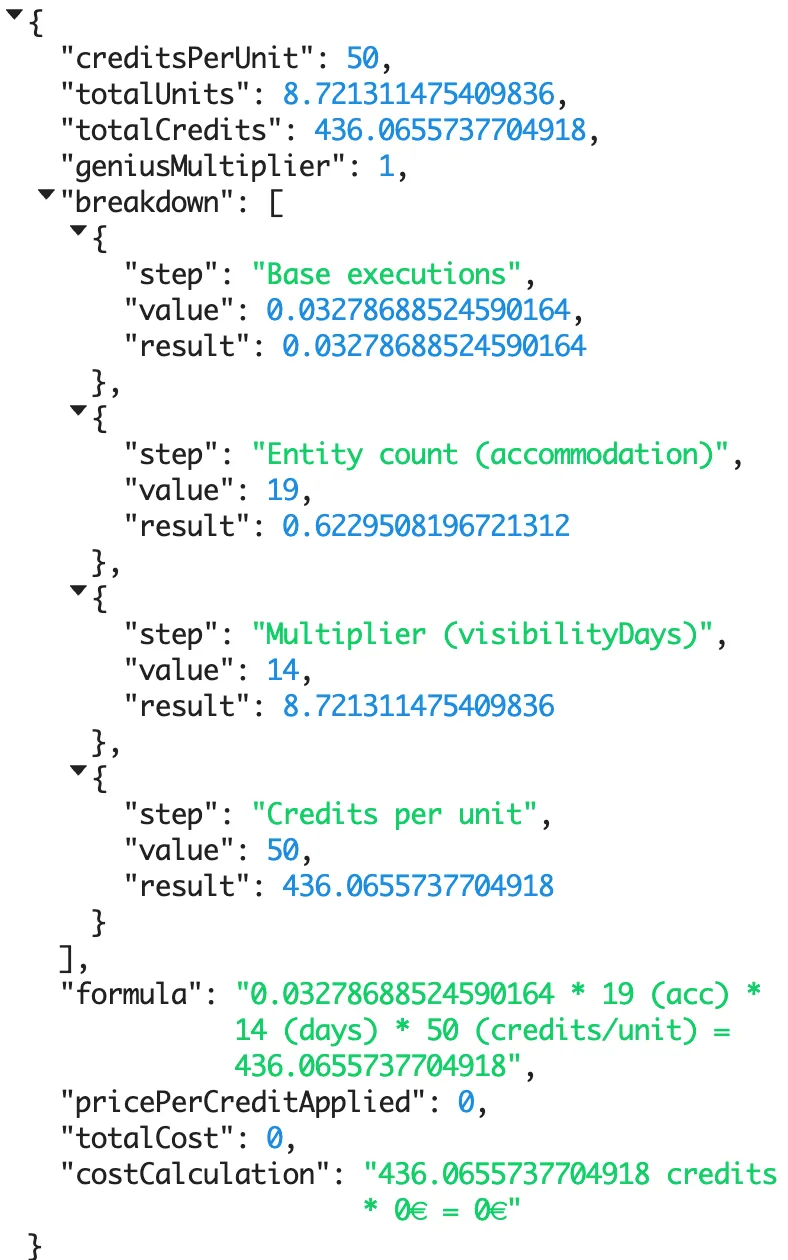
Read it bottom up:
0.0328 (base executions) × 19 (accommodations) × 14 (visibilityDays) × 50 (credits/unit) = 436.07
So the 437 credits were not a mystery: 19 hotels, 14 days of forward visibility, 50 credits per unit. Which immediately tells you the two levers — drop the entity count or drop the visibility window — and roughly what each would save. The dialog also carries pricePerCreditApplied and costCalculation, so you can see the euros as well as the credits.
Never reconstruct this by hand. The formula lives in the product and it changes per API; this dialog is the authority.
Before you spend: estimate, don't guess
Two estimators run before the money moves:
- The import dialog. Every Feed import shows an Estimated cost with the entities and parameters you picked. Change the visibility days and watch it move.
- The schedule estimator. When you create or edit a schedule, it shows the cost per run and the monthly equivalent for the frequency you chose. That second number is the one that decides whether a daily schedule is sane.
And for the bigger question — "what would it cost us to cover 40 hotels and 3 cities?" — there is Simulations: you build the scenario, add the APIs with their parameters, and read the totals. It spends nothing. It is the right tool for sizing a plan or answering a customer, and it beats arithmetic on a napkin.
Getting it out of the dashboard
Export gives you the period as XLSX, one row per consumption line, which is what you want for reconciling against your own numbers. Billing data holds the invoicing details, and Invoices has the issued invoices with their PDFs.
One thing the API does not do today: there is no public endpoint that returns your consumption. GET /v2/account/customer-info gives you the plan, the concurrency limits, the authorised IPs, the webhook and your schedules — useful for knowing your ceilings — but the credit figures live in the dashboard and in the XLSX export.
What happens next
If the pattern you find is "we are consistently over", Plans is where you change tier — monthly or annual, with the annual discount — and a pending downgrade can be cancelled from the same screen until it takes effect. If the pattern is "one API is eating everything", the per-API Usage tab on that API's page shows the same table filtered, which is usually a faster way to find the offending schedule.
Questions
Why did this request cost me nothing?
Look at the CACHED column. A response served from cache costs nothing or less than a fresh one. The second place to look is TRIGGER: a run you didn't start yourself may be a schedule or a recovery retry.
What exactly is a credit?
A unit of work, priced differently per API. Realtime endpoints charge per request. Feed imports charge per entity and per day of visibility, times a credits-per-unit figure that belongs to that API. The Calculation details dialog shows the exact multiplication for any line, which is the only reliable way to know.
Why is one import 437 credits and another 0,32?
Because the formula multiplies. The 437 one covered 19 accommodations across 14 days of visibility at 50 credits per unit; the 0,32 one was a single location search for one night. Entity count and visibility window are the two levers, and both are visible in the import dialog before you launch.
How do I find out what something will cost before running it?
Three places, in order of size: the Estimated cost in the import dialog, the per-run and monthly figures in the schedule estimator, and the Simulations tab for a whole scenario. All three are free.
Can I pull my consumption over the API?
Not today. There is no public usage endpoint. GET /v2/account/customer-info returns your plan, concurrency limits, authorised IPs, webhook and schedules, but not credits consumed. For consumption, use the dashboard or the XLSX export.
The credits chip says I have exceeded my plan. What happens?
Consumption above your plan is billed on demand at your price per credit, which appears in the summary bar as Cost per 1.000 credits. The Plans tab is where you change tier if that becomes the norm rather than the exception.
Build your own
Start free with 1,000 API credits. No credit card, no sales call.
What do you want to build?
Say it in one line and we hand you back the prompt for our MCP, the recipe that already builds it, and the APIs it runs on.