Event Demand Radar
See which events will fill a city before your comp-set does. For every event: the extra hotel roomnights it generates, how hard it presses the city's room inventory, and the booking window you need to price ahead of.
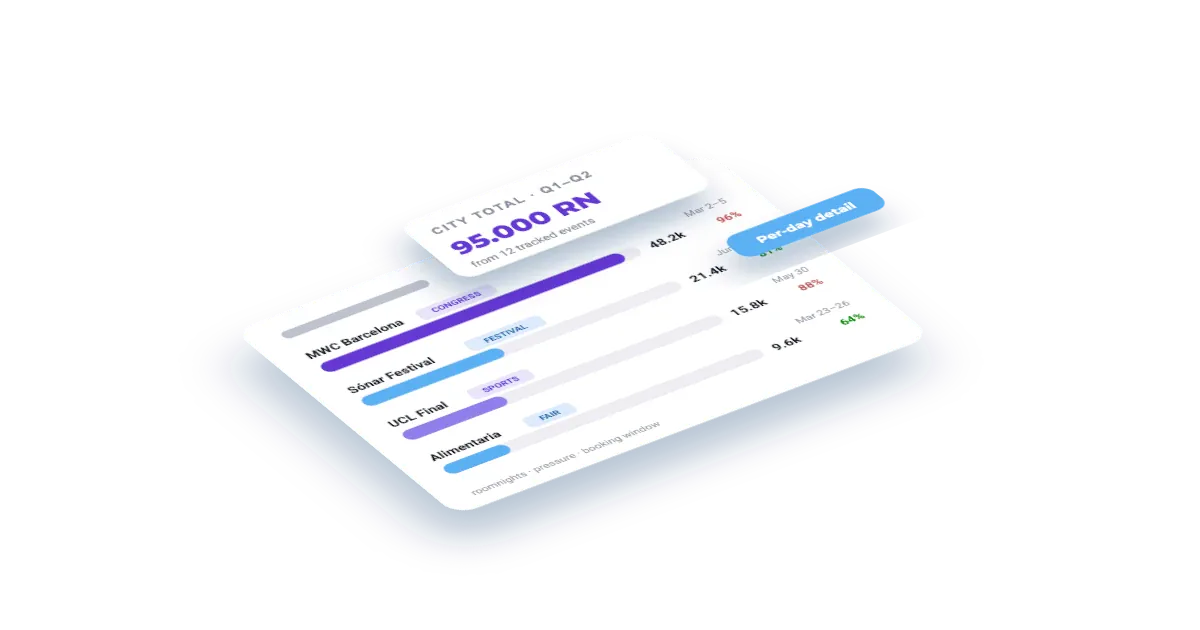
What you'll build
A demand calendar for any city: events ranked by how hard they squeeze hotel inventory, each with a day-by-day roomnights curve split by hotel tier, the booking window, who actually sleeps in a hotel versus locals who don't, and how far from the venue they stay.
Set this up first
RequiredThe endpoints don't take free text — they take your identifiers. This recipe assumes the things below already exist on your account; while one of them is missing the call answers empty, not with an error. Each point links to the recipe that walks it.
- 01
Register the city as a location
The events feed answers by location id. The name is validated against the real destination, so pick the right one: four cities in four countries are called Barcelona.
Guide: Add a city and see the demand its events will create →
How it works
- 01
Get your API key
Create your account and copy your key. Start free with 1,000 API credits.
- 02
Pick your city
List the locations configured on your account and copy the id of the city you want to track.
- 03
Pull the events feed
Ask for a date range and a minimum impact. Every event comes back with its hotel demand already modelled.
The call
One request returns every event with its hotel impact already modelled. Swap in your location id and your key.
curl "https://api.veetal.app/v2/feed/events/YOUR_LOCATION_ID?from_date=2026-08-01&to_date=2027-07-31&min_impact=medium" \
  -H "veetal-api-key: YOUR_API_KEY"
Build it with AI
Connect the MCP →Paste this prompt into an assistant with the Veetal MCP connected and it builds the whole app against your data — no front-end work.
Use my Veetal Connect data to build an "Event Demand Radar" for Barcelona,
covering the next 12 months.

I want to know which events will drive hotel demand in the city, how hard they'll
push it, and when to price for them. Work out what data you need and fetch it.

Build it as a single self-contained web page I can open and share:

- A year view: one bar per month showing how much hotel demand that month carries.
  I click a month to explore it.
- The selected month: its events ranked by how hard they squeeze the city, each
  showing how busy it gets and how many roomnights it brings.
- An event detail: how demand builds and fades day by day, which hotel tiers absorb
  it, when the booking window opens and closes, who actually shows up - separating
  the people who sleep in a hotel from locals who don't - and how far out from the
  venue they stay.
- Surface where attendance is misleading: big crowds that generate little hotel
  demand, and smaller events that generate a lot.
- Flag anything that pushes the city past its room capacity.

Two layouts, switchable: a full page, and a compact floating widget pinned to the
bottom-right corner that shows the month navigator and that month's top events.

Clean and modern, works in light and dark. Use only real values from my data -
never invent numbers. If something isn't available, leave it out.
See it working
A working dashboard built on real Barcelona data: 92 events across 12 months, with month navigation, per-event detail and a floating widget layout.
Open the live demo ↗Questions
Where does the hotel impact come from?
Veetal combines an events catalogue with a hotel-impact model that estimates attendance, splits it into audience profiles, and converts it into roomnights, pressure against the city room inventory, booking window and geographic distribution.
Is this live scraping?
No. Events is a pre-processed Feed dataset, so it is fast to read and already enriched. You get structured JSON, not raw pages.
Why not just count attendance?
Attendance alone misleads. A street festival can draw over a million people and generate fewer roomnights than a 60,000-visitor international festival, because most attendees are locals who don't book a room. The model separates the two.
What does pressure mean?
It is the share of the city's room inventory the event demands on a given night. It can exceed 100%, which means demand outstrips the rooms available — a sell-out signal.
Build your own
Start free with 1,000 API credits. No credit card, no sales call.
What do you want to build with events?
Say it in one line and we hand you back the prompt, the recipe if one already exists, and the APIs it runs on — starting with events.