Read the sold-out signals before your comp set does
Your PMS knows your pace. It knows nothing about the market's. By the time a spike shows up in your own bookings the rest of the city has already repriced, and the nights you sold cheap were the ones everyone else sold out of. Availability across the market is the earliest signal there is.
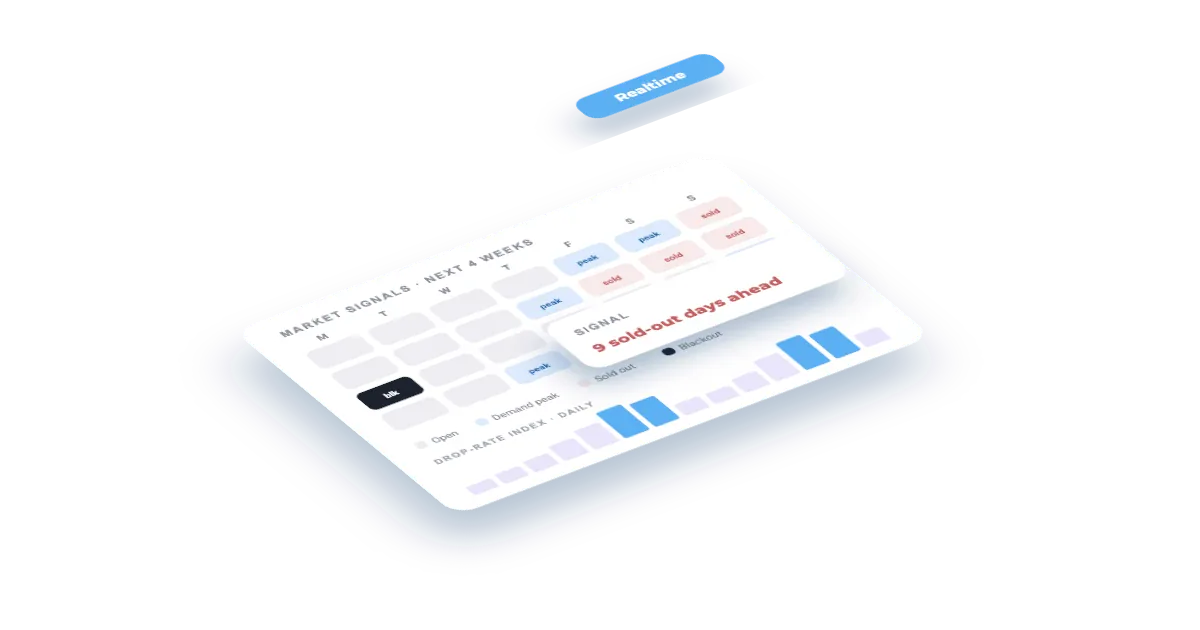
What you'll build
A demand calendar built from what is left on sale rather than from what you have sold: which nights the market is closing out, where the spikes are forming, which dates have blackout patterns, and how your own pace compares — by source, if your PMS is imported.
Set this up first
RequiredThe endpoints don't take free text — they take your identifiers. This recipe assumes the things below already exist on your account; while one of them is missing the call answers empty, not with an error. Each point links to the recipe that walks it.
- 01
Register the hotel in your dashboard
Veetal resolves the property against Booking.com and assigns it a slug — and that slug, not the hotel name, is what every accommodation endpoint takes.
Guide: Add your hotel and the comp set you price against → - 02
Fill in its comp set
Up to ten competitors on the accommodation detail. Without them this recipe prints your own price list instead of a comparison, and the competitors block comes back empty.
How it works
- 01
Decide the window that matters
Pace signals are useless at ninety days and gold at fourteen. Pick the window where you still have levers and stop scanning beyond it.
- 02
Read the market, then read yourself
Market availability first, your own reservations second. The interesting number is the gap: nights where the city is filling and you are not.
- 03
Watch the disappearances
The signal is not what is priced, it is what stopped being priced. A property leaving the listing for one date is worth more than any rate it published.
The call
Availability for a date range tells you what is still on sale. What is missing from the answer is the part worth reading.
curl "https://api.veetal.app/v2/real-time/accommodation/YOUR_SLUG/availability/2026-10-01/2026-10-31/2" \
  -H "veetal-api-key: YOUR_API_KEY"
Build it with AI
Connect the MCP →Paste this prompt into an assistant with the Veetal MCP connected and it builds the whole app against your data — no front-end work.
Using my Veetal Connect data, find the demand signals in the next 30 nights for my
market.

Look at availability across my comp set night by night, and tell me:
- which nights are closing out — properties that had a rate and no longer do
- whether that is one property (noise) or several (signal)
- where the spikes cluster, and whether an event in the city explains them
- any blackout pattern: dates nobody is selling, which usually means something
  structural rather than demand

If my PMS reservations are imported, compare my own pace on those nights to the market
and tell me where the gap is widest. If they are not imported, say so — do not guess at
my occupancy.

Rank the nights by how much I should care, and for the top three tell me what you would
do tonight. Be explicit about which signals are strong and which are one property away
from being nothing.
Questions
Does this need my PMS connected?
Not for the market half — availability across the comp set works with nothing but your API key. The PMS import adds your own pace and the by-source split, which is what turns a market signal into a decision about your inventory.
How early is early?
Earlier than your own booking curve, which is the point. A market closing out for a date you still have wide open is a warning you get days before the reservations would have told you.
Is a missing rate really a sold-out?
Usually, not always — a property can close a channel or fail an extraction. Treat one disappearance as noise and a pattern across several properties as a signal.
Can it explain a spike?
Cross it with events. A cluster of sold-out nights with a congress underneath it prices differently from the same cluster with no explanation — one repeats next year, the other might not.
Build your own
Start free with 1,000 API credits. No credit card, no sales call.
What do you want to build with availability?
Say it in one line and we hand you back the prompt, the recipe if one already exists, and the APIs it runs on — starting with availability.