Feed live rates into your pricing engine
Scheduled imports are the right tool for trends and the wrong one for reactions. When a competitor closes out for a Saturday at four in the afternoon, a nightly feed tells you tomorrow. The Real Time family exists for the decisions that cannot wait for tomorrow.
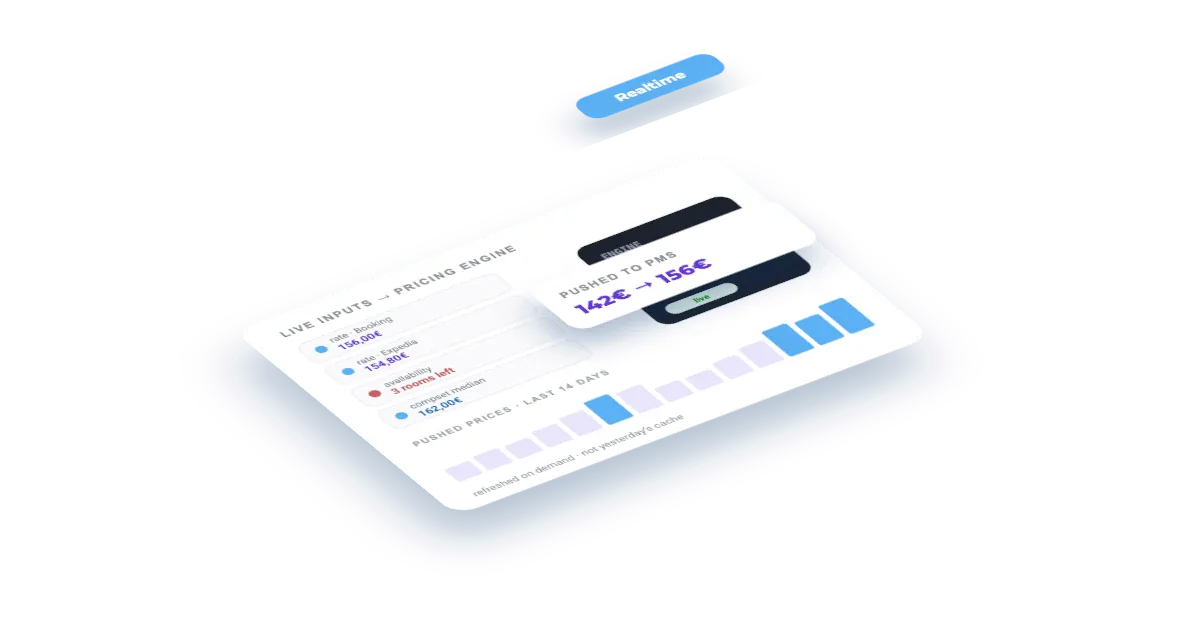
What you'll build
The inputs your pricing engine is missing: live competitor rates and availability for the dates you are pricing right now, with a clear read on what changed since your last scheduled extraction and whether it warrants a move.
Set this up first
RequiredThe endpoints don't take free text — they take your identifiers. This recipe assumes the things below already exist on your account; while one of them is missing the call answers empty, not with an error. Each point links to the recipe that walks it.
- 01
Register the hotel in your dashboard
Veetal resolves the property against Booking.com and assigns it a slug — and that slug, not the hotel name, is what every accommodation endpoint takes.
Guide: Add your hotel and the comp set you price against → - 02
Fill in its comp set
Up to ten competitors on the accommodation detail. Without them this recipe prints your own price list instead of a comparison, and the competitors block comes back empty.
How it works
- 01
Know what it costs before you loop
Real Time calls are billed per request and take seconds, not milliseconds. A loop over sixty dates and eight competitors is four hundred and eighty calls — decide the budget before you write the code.
- 02
Use the feed for the baseline, real time for the delta
Read your scheduled extraction for the shape of the market, then spend live calls only on the dates where the decision is actually close. That is the pattern that keeps the bill sane.
- 03
Feed it in, do not read it out
The output belongs in your pricing engine, not on a dashboard a human refreshes. Anything a person has to look at every hour will not be looked at.
The call
A live availability check for one accommodation and one date range. Seconds, not milliseconds — and billed per call.
curl "https://api.veetal.app/v2/real-time/accommodation/YOUR_SLUG/availability/2026-10-10/2026-10-12/2" \
  -H "veetal-api-key: YOUR_API_KEY"
Build it with AI
Connect the MCP →Paste this prompt into an assistant with the Veetal MCP connected and it builds the whole app against your data — no front-end work.
Using my Veetal Connect data, help me decide whether to move my price for this
coming Saturday.

Work in two passes so we do not burn credits unnecessarily:

1. First read what is already stored — my scheduled extraction of my rates and my comp
   set's. Tell me what it says and how old it is.
2. Then, only for Saturday and only for the competitors where the stored picture is
   close or stale, make live calls for current rate and availability.

Tell me before the second pass how many live calls you intend to make.

Then answer: has anything moved since the extraction, has anyone closed out, and does
that justify a change tonight? Give me the number I should move to, or tell me to leave
it alone. If the live data contradicts the stored data, say which you trust and why.
Questions
Why not just call real time for everything?
Cost and latency. A live call goes to the OTA and waits for it; sixty dates is a minute of waiting and a real bill. The feed exists so you only spend live calls where they change a decision.
How fresh is "real time"?
It is fetched when you ask, subject to a short cache you can bypass. That is as current as the OTA itself.
Does it give me availability or just price?
Both, and availability is the underrated half. A competitor with no rate for a date has usually closed out, which moves your pricing more than any number they published.
What if the call times out?
Treat it as no data rather than as zero demand, and fall back on the last stored extraction. A pricing engine that reads a timeout as an empty market will do something stupid.
Build your own
Start free with 1,000 API credits. No credit card, no sales call.
What do you want to build with market demand?
Say it in one line and we hand you back the prompt, the recipe if one already exists, and the APIs it runs on — starting with market demand.