Rate Parity Monitor
Parity leaks quietly and costs you the direct booking. This recipe reads the parity comparison for your hotel against its comp set for a date range, so you can see the nights and channels where your rate is undercut.
What you'll build
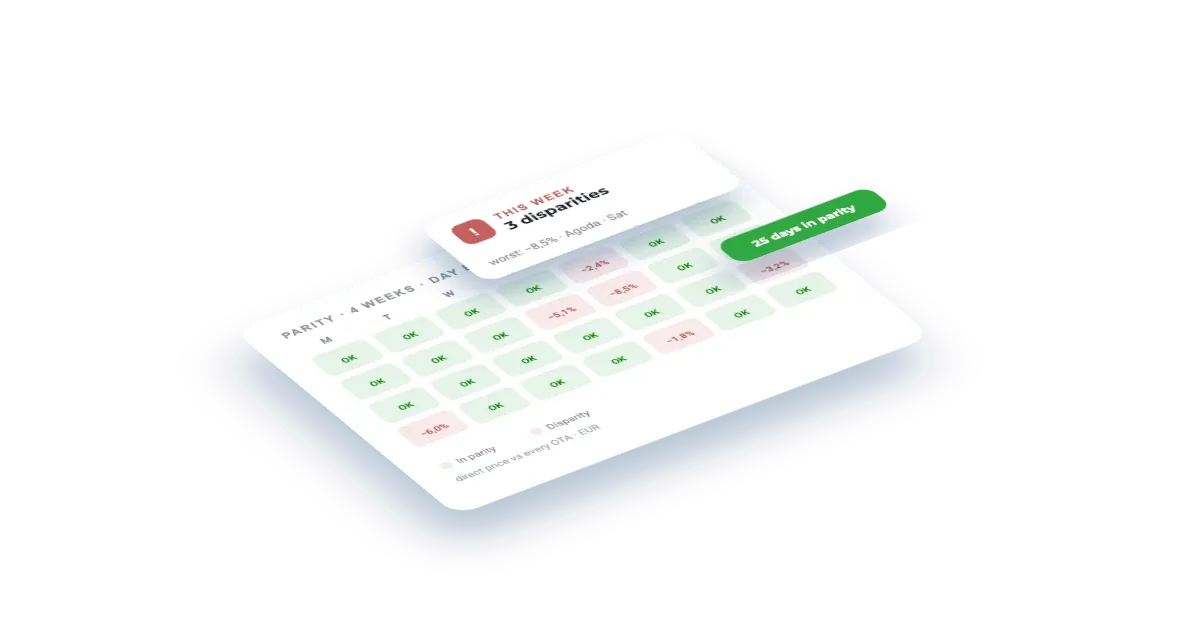
A parity dashboard: a night-by-night list with the parity score, the best rate found per competitor, and the gaps highlighted so a leak is obvious without reading numbers one by one.
Set this up first
RequiredThe endpoints don't take free text — they take your identifiers. This recipe assumes the things below already exist on your account; while one of them is missing the call answers empty, not with an error. Each point links to the recipe that walks it.
- 01
Register the hotel in your dashboard
Veetal resolves the property against Booking.com and assigns it a slug — and that slug, not the hotel name, is what every accommodation endpoint takes.
Guide: Add your hotel and the comp set you price against → - 02
Fill in its comp set
Up to ten competitors on the accommodation detail. Without them this recipe prints your own price list instead of a comparison, and the competitors block comes back empty.
- 03
Run one import on the hotel
A Feed dataset only contains what an import has written. Activate this API on the hotel, launch the first run by hand and read the credit estimate before you press — the cost grows with the comp set and with the OTAs.
Guide: Import a hotel's reputation from Booking →
To see whether an import has already finished, list them:
curl "https://api.veetal.app/v2/account/imports" \
  -H "veetal-api-key: YOUR_API_KEY"
Feed reads are not billed per request. The credits go on the imports that collect the data, which is why the estimate appears before you launch and not after.
How it works
- 01
Get your API key
Create your account and copy your key. Start free with 1,000 API credits.
- 02
Pick your hotel
List the accommodations on your account and copy the slug of the hotel you want to monitor.
- 03
Read the parity window
Ask for a date range and the feed returns the parity score and the best rate per competitor for each night.
The call
One request returns the parity score and the best competing rate for every night in the range. Swap in your hotel slug and your key.
curl "https://api.veetal.app/v2/feed/accommodation/YOUR_HOTEL_SLUG/parity?from_date=2026-09-01&to_date=2026-09-30&adults=2" \
  -H "veetal-api-key: YOUR_API_KEY"
Build it with AI
Connect the MCP →Paste this prompt into an assistant with the Veetal MCP connected and it builds the whole app against your data — no front-end work.
Use my Veetal Connect data to build a rate parity monitor for my hotel,
covering next month.

I want to see where my rate is being undercut: for every night, how my price
compares across the channels and against the hotels I compete with. Work out
what data you need and fetch it.

Build it as a single self-contained HTML page, plain HTML and CSS:

- A night-by-night list, worst parity first, so the problems are at the top.
- For each night: my rate, the best competing rate, the gap in money and in
  percent, and a clear flag when I am undercut.
- A summary at the top: how many nights are out of parity, and the worst one.
- Let me switch between desktop and mobile rates if the data has both.
- Never invent a rate — leave the night out when there is no data for it.

Clean, scannable, works in light and dark.
Questions
What is a parity score?
A single number summarising how your rate compares with the rates found for the same night across the set, so you can sort nights by severity instead of eyeballing every price.
Does it cover mobile rates?
The endpoint takes a device parameter, so you can read desktop or mobile. Mobile-only discounts are a common source of silent parity leaks.
How fresh is the data?
It is the pre-processed Feed layer, refreshed on your account schedule. For a price at this exact second, use the real-time parity endpoint instead.
What date range should I ask for?
It defaults to today. Pass from_date and to_date to cover a booking window — a month ahead is a common choice for spotting leaks before they cost you bookings.
Build your own
Start free with 1,000 API credits. No credit card, no sales call.
What do you want to build with disparities?
Say it in one line and we hand you back the prompt, the recipe if one already exists, and the APIs it runs on — starting with disparities.