Find out what guests actually complain about
A score of 8.7 tells you nothing you can act on. The reviews underneath it do, but nobody reads four hundred of them across five OTAs — so hotels end up managing the number instead of the thing the number measures. With the MCP connected, the assistant reads all of them and tells you what they say.
What you'll build
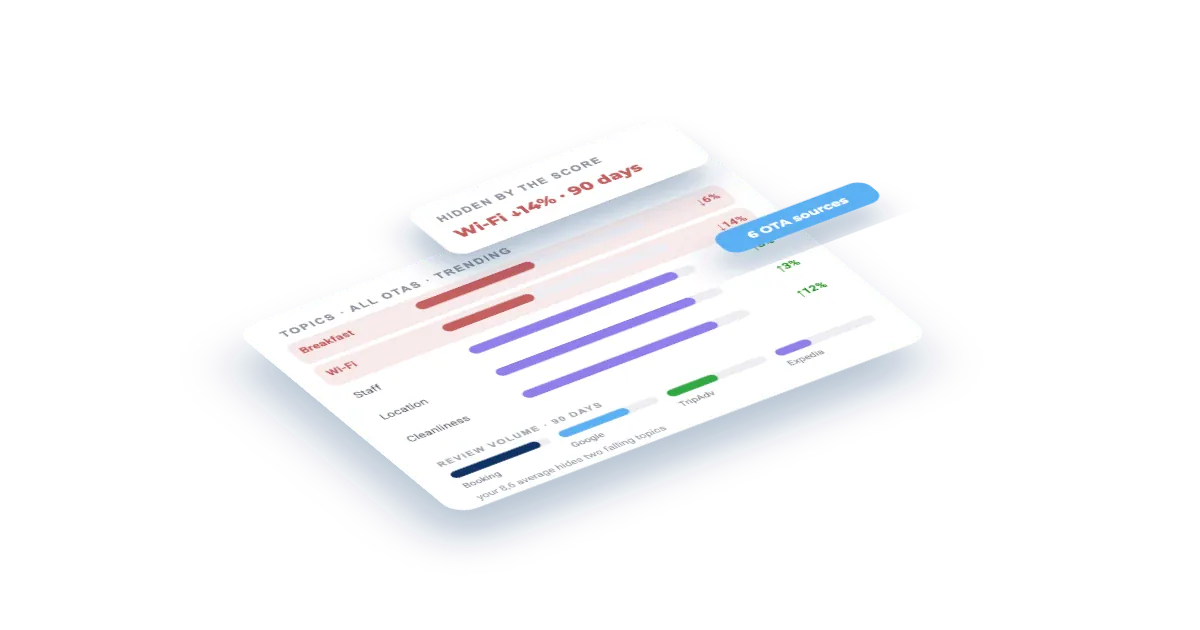
A written read of your reviews: the themes that keep coming up, ranked by how often and how angrily; which have got worse since last quarter; where the OTAs disagree about you; and the handful of specific, cheap fixes the text points at.
Set this up first
RequiredThe endpoints don't take free text — they take your identifiers. This recipe assumes the things below already exist on your account; while one of them is missing the call answers empty, not with an error. Each point links to the recipe that walks it.
- 01
Register the hotel in your dashboard
Veetal resolves the property against Booking.com and assigns it a slug — and that slug, not the hotel name, is what every accommodation endpoint takes.
Guide: Add your hotel and the comp set you price against → - 02
Run one import on the hotel
A Feed dataset only contains what an import has written. Activate this API on the hotel, launch the first run by hand and read the credit estimate before you press — the cost grows with the comp set and with the OTAs.
Guide: Import a hotel's reputation from Booking →
To see whether an import has already finished, list them:
curl "https://api.veetal.app/v2/account/imports" \
  -H "veetal-api-key: YOUR_API_KEY"
Feed reads are not billed per request. The credits go on the imports that collect the data, which is why the estimate appears before you launch and not after.
How it works
- 01
Import the reviews
Reputation is a Feed dataset: the reviews have to be collected before they can be read. Set the accommodation up and run an import — the reputation recipe walks through it.
- 02
Ask what the text says
Not "what is my score" — that you already know. Ask what the complaints have in common, and what the five-star reviews praise that you are not putting in your marketing.
- 03
Ask what changed
The single most useful question is comparative: which theme is more frequent now than it was six months ago. That is where a problem is forming.
The call
The assistant reads the reviews feed. This is the call it makes, if you would rather see the raw text yourself.
curl "https://api.veetal.app/v2/feed/accommodation/YOUR_SLUG/reviews?include_competitors=false&limit=200" \
  -H "veetal-api-key: YOUR_API_KEY"
Build it with AI
Connect the MCP →Paste this prompt into an assistant with the Veetal MCP connected and it builds the whole app against your data — no front-end work.
Using my Veetal Connect data, read my hotel's reviews across every OTA and tell me
what guests actually say.

Take the last 200 reviews. Ignore the score for a moment and work from the text.

1. What themes recur? Rank them by how often they appear and how strongly they are
   worded. For each one, quote two real reviews — if you cannot quote it, do not list it.
2. Which themes appear more now than in the equivalent window a year ago, and which
   have faded? That trend matters more than the absolute count.
3. Where do the OTAs disagree about me? A complaint that only shows up on one platform
   usually means a different guest profile, not a different hotel.
4. What do the best reviews praise that my marketing does not mention?
5. Of everything above, what would be cheap to fix and what would need capital?

Tell me explicitly what you could not determine — how many reviews had no text, how
many you could not date, whether the sample is thin for any period.
Questions
Is this the same as the category scores the OTAs already give me?
No. Those are fixed buckets — cleanliness, staff, location — scored on a scale. The text says things no bucket has: that the lift is slow at breakfast time, that the new mattresses fixed the sleep complaints, that guests keep expecting a bar you do not have.
How many reviews can it read?
The feed returns up to 200 per request and pages beyond that. For a busy hotel, ask for a window — the last quarter — rather than everything at once; the recent ones are the ones you can act on.
Will it invent themes?
It can, and that is the risk. Ask it to quote two or three actual reviews for every theme it names. A theme that cannot be quoted was not there.
Can it separate languages?
Booking reports the review language; Google does not. Ask for the split and expect it to be partial — and to be told which reviews it could not classify.
Build your own
Start free with 1,000 API credits. No credit card, no sales call.
What do you want to build with reviews?
Say it in one line and we hand you back the prompt, the recipe if one already exists, and the APIs it runs on — starting with reviews.